
Three dimensions of a safer church mindset.
There seems to be a new language everywhere we turn. Sit down with a physician, consult an attorney, or try to keep pace in a Gen-Z conversation, and suddenly you’re mired in unfamiliar territory.
Thankfully, the language of church security is far more accessible. Even better, it’s practical. Once understood, it reshapes how we see, think, and act in ways that genuinely protect people.
Let’s explore three key concepts that work together to create safer church environments: situational awareness, spherical awareness and shared awareness.
Situational awareness: the foundation
Most people involved in safety ministries have heard the term situational awareness. At its core, it’s simple: it’s the ability to perceive, understand, and anticipate what’s happening around you in real time.
It’s the bedrock of sound decision-making, whether in daily life, emergency response, or church security.
Through ALICE Instructor Certification Program training (Navigate360), this concept is emphasized as the backbone of survival in violent intruder or active threat situations. ALICE defines situational awareness as being fully aware of your surroundings, the people within them, and your circumstances so you can recognize and respond to threats proactively, rather than defaulting to passive, frantic or desperate reactions.
ALICE integrates this awareness into its five strategies:
Alert: Recognize a threat and communicate it immediately
Lockdown: Secure spaces effectively and reassess continuously
Inform: Share real-time updates to guide decisions
Counter: Use your environment defensively if necessary
Evacuate: Move to safety when conditions allow
The message is clear: awareness isn’t passive. It equips people to act with purpose.
Here’s a helpful lens:
One widely used model for understanding situational awareness is the Cooper Color Code, developed by Colonel Jeff Cooper. It describes mental states of readiness:
Condition white: Unaware and unprepared
Condition yellow: Relaxed but alert, scanning the environment
Condition orange: Focused on a specific potential threat
Condition red: Action is required
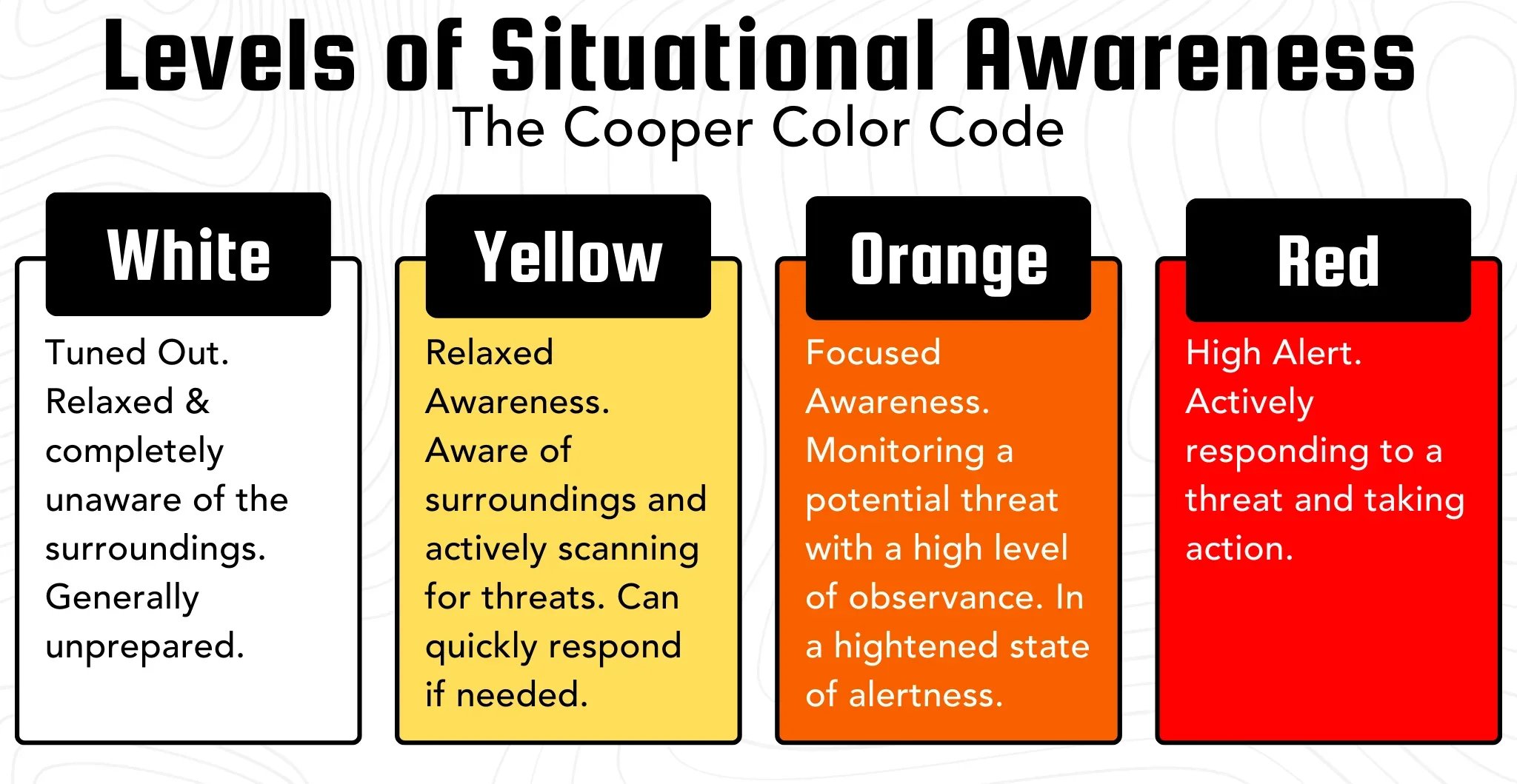
Some also describe Condition Black, where panic overrides the ability to respond.
For church safety teams, Condition Yellow is the goal. Calm, observant, and ready to shift gears if needed. Not anxious, not distracted, but quietly attentive.
Another Framework: Perception/Comprehension/Projection
Situational awareness can also be understood in three stages:
Perception: Noticing what’s happening around you
Comprehension: Understanding what it means
Projection: Anticipating what could happen next
This progression turns raw observation into informed action. A person rushing through a hallway may be nothing. Or it may signal urgency, distress, or danger. Awareness lies in connecting those dots.
Sharpening awareness: practical habits
Situational awareness is a skill that can be developed and taught. A few simple practices make a measurable difference:
Limit distractions, especially mobile devices
Periodically scan your surroundings instead of fixating on one point
Identify exits and safe routes in any environment
Mentally rehearse scenarios using “What if?” thinking
These habits quietly train the mind to stay engaged rather than drift into autopilot.
The OODA Loop: awareness in motion
Another powerful tool is the OODA Loop: Observe, Orient, Decide, Act.
Originally developed for military pilots, it’s now widely used in emergency response and decision-making under pressure.
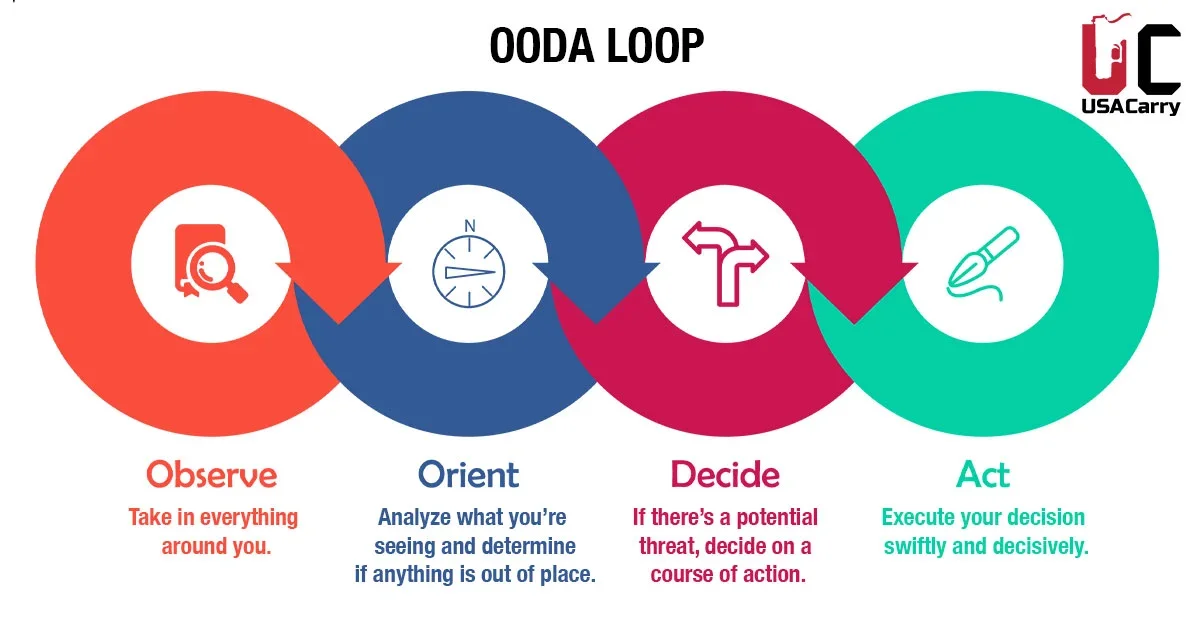
Observe: Gather information
Orient: Interpret it based on experience and context
Decide: Choose a course of action
Act: Carry it out
Then the loop begins again. The goal is not perfection. It’s responsiveness. The faster and more accurately someone cycles through this loop, the more effectively they can adapt to changing conditions.
Spherical awareness: expanding the field
If situational awareness is the foundation, spherical awareness is the expansion.
Rather than thinking in a straight line or narrow field, imagine awareness as a sphere that surrounds you, extending in all directions. Not just what’s in front of you, but beside you, behind you, above, below, and even beyond immediate sight.
Pilots embody this concept. They rely not only on vision, but also on instruments, sound, and physical cues. Their awareness is layered and multidimensional.
In a church setting, spherical awareness includes:
Visual observation of people and spaces
Awareness of sounds and unusual noise patterns
Sensitivity to physical cues or environmental changes
Recognition of smells that may indicate hazards
While church teams don’t operate at fighter pilot levels, the principle still applies. Awareness should be broad, active, and continuously adjusting.
Technology extends this sphere. Cameras, alarms, radios, and team communication act as additional “eyes and ears,” expanding what any one person can perceive.
Why it matters
Many incidents, both serious and minor, share a common thread: something was noticed too late.
Early awareness creates options.
Whether the concern is a suspicious individual, a medical emergency, severe weather, or a fire risk, recognizing it sooner allows for calmer, more effective response
Spherical awareness increases the chances of early detection. It widens the margin for action.
Shared awareness: multiplying effectiveness
No individual sees everything. That’s where shared awareness becomes essential.
When one person observes something and communicates it, the entire team becomes more capable.
Consider simple examples:
Closing and securing an open door
Straightening a tripping hazard
Moving a combustible item away from heat
Noticing and reporting unusual behavior
Individually, these actions may seem small. Collectively, they prevent incidents.
The phrase “See something, say something” captures this well:
See it: notice what’s out of place
Say it: communicate it to someone who can act
Equally important is documentation. Logging observations helps identify patterns and prepares others to recognize similar concerns.
The role of communication and patrol
Shared awareness thrives on communication. Whether through radios, direct conversation, written reports, or digital messaging, the goal is simple: keep information moving.
One of the most common frustrations in any organization is the phrase, “Why didn’t anyone tell me?”
Good communication eliminates that gap.
Patrolling also plays a key role. A moving team member naturally expands their field of awareness. When those observations are shared, the entire team benefits from that expanded perspective.
Awareness, in this sense, becomes collective rather than individual.
Awareness in motion
Spherical awareness isn’t static. It’s active and mobile.
A security team member should never be rooted in place or mentally checked out. Awareness should move, sweep, and adjust.
This may involve:
Monitoring cameras while remaining attentive to the physical environment
Listening to radio communication while observing nearby activity
Remaining open to anything that feels out of place
On the Cooper scale, this is Condition Yellow in motion. Calm, alert, and ready to shift if needed.
Bringing it all together
Each member of a church safety team operates from a central point, surrounded by a sphere of awareness.
To be effective, that awareness must be:
Situational: Understanding what’s happening
Spherical: Expanding perception in all directions
Shared: Communicated for the benefit of others
When these three work together, awareness becomes more than a concept. It becomes a culture. And in that culture, safety isn’t reactive. It’s attentive, coordinated, and quietly prepared.
Not anxious. Not overbearing. Just present.
Right where it needs to be.